Sunday, November 2, 2008

Who put it together? (Old Testament)

As you read in the Intro to this series, I do believe the bible is a remarkable book, but allow me to clarify, these posts are not about the religious or spiritual side of the bible, but rather a more historical orientation of it, I do hope that the end result for you and me is a better understanding of its origins.

The natural place to start my research was searching for information on the Old Testament, after all, it is “Old” for a reason.

As expected, the complexity of the Bible extends masterfully to its origins as well, and this is a big part of why this post has taken me longer than expected to complete; Please bare in mind that this series is not intended to be a historical reference, but a compilation, summary and interpretations of my findings on the bible’s origins; and as usual, I strongly recommend you double check any fact with your sources when in doubt.

It is believed the Old Testament was originally written between the 10th and 6th century BC by anonymous authors, but unfortunately, the “original” text of these books does not exist today; actually, the oldest fragment of the Hebrew Bible is a small silver amulet, dating approximately 600 BC which contains a portion of the priestly blessing (“May God make his face to shine upon you…”, NM: 6:22-27).

Important Note: The Old Testament is not 100% equal to the Hebrew Bible (Tanakh), according to tradition and the Talmud, which is almost as important as the Hebrew Bible itself for the people of Israel (it contains rabbinic discussions pertaining the Jewish law, ethics, customs and history), The Hebrew Bible was compiled by “The Great Assembly” around the year 450BC and has since remained unchanged (point of discussion by modern scholars).

The Hebrew Bible/Old Testament exists today in several traditions, including the Septuagint, the Masoretic Text and the Dead Sea Scrolls:

  • The Septuagint Is the oldest of several ancient translations of the Hebrew Bible into Greek, it is believed to have been translated between the 3rd and 1st centuries BC. Its name comes from the tradition that seventy (or seventy-two) Jewish scholars translated the Torah around 285-246 BC. It is interesting to know that the Septuagint includes some books not found in the Hebrew Bible nor most Protestant Bibles (like the “Apocryphal books”.
  • The Masoretic Text is the Hebrew Text of the Tanakh, however, it not only defines the Jewish Canon, but also the precise letter-text of the biblical books in Judaism, as well as their vocalization and accentuation for both public reading and private study, and this is the basis of the translations of the Old Testament in protestant Bibles. It dates between the seventh and 10th centuries AD.
  • The Dead Sea Scrolls consist of roughly 1,000 documents, including text from the Hebrew Bible which were discovered between 1947 and 1956 in eleven caves. Needless to say these texts are of great religious and historical significance, these are the only known surviving copies of Biblical Documents made before 100 AD.

Also, it is very interesting to know that there are numerous differences between the Septuagint and the Masoretic Text, some are very big differences and some subtle; it was generally believed that the Septuagint provided a reasonably accurate record of an early Semitic textual variant, now lost, that differed from ancestors of the Masoretic Text; however, many of the fragments found in the Dead Sea Scrolls agree with the Septuagint rather than the Masoretic Text, this proves that these variants were also present in early Semitic manuscripts.

It is also important to know that these translations vary considerably from book to book, from literal to paraphrasing to interpretative, which makes it even harder to determine the validity and/or change(s) over time.

There is/was/has been a lot of debate between the scholars that selected the “inspired books”, by the way, in case is not evident, the compilation of the bible is a product of human selection, the Canon was selected by region, approximate date, style of writing and doctrine, many books were left out because of conflicting doctrine (like the Apocryphal books) and some were added to the cannon by a majority of votes.

Even Martin Luther (father of Protestantism) questioned the validity of several books including: Hebrews, James, Jude and Revelation (and currently also in question are: 2 peter, 2 and 3 John), more on this on Part 2.

As usual, make your own conclusions about this info. It is even tougher for me to believe in an “inspired” book, when there’s no apparent “divinity” in the selection process and no valid “recorded evidence” of its origins.

More on Part 2 – The New Testament

Thursday, October 30, 2008

Who put it together? (Intro)

When having an argument over anything related to religion I used to say something like: “I just won’t argue outside of the bible, this is my battleground, after all… the bible is the word of God, so anything outside of the bible is just not worth discussing for me.”; It was always surprising to me how well that worked, it seemed to me that the vast majority of people are not confrontational and just won’t go the extra mile and come up with alternative thoughts to expose their views in situations like this.

The bible is a remarkable compilation, it was written by different authors, hundreds of years apart, It has unarguably stand the test of time being the most printed book in human history, most of its advices (non-related to war) are considered “good practices” by (almost) everybody and if that is not enough It manages to convince people of its validity and its contents singlehandedly… If you don’t think this is true, I encourage you to write an essay about something of importance to humanity, give it to as many people you can and ask for their opinion and also if they would be willing to live by your teachings, I’m pretty sure their reactions will put the relevance of the bible in perspective.

I was actually fascinated by this on an intellectual level, and then I realized I had no idea who compiled all the books, right then I knew it was time to research, clear some doubts and write the post :).

This is the Introduction of a series of posts in the subject, I found a LOT of information which I’m currently compiling and checking sources, but the plan is to break everything into different posts:

  1. The Old Testament
  2. The New Testament
  3. Apocryphal books
  4. The Bible

Hopefully I’ll have the first post up before week’s end, I’m honestly very excited about these posts, but unfortunately have been very busy @work lately, which is why I have not been able to post faster, having said that, I do appreciate your understanding,

Faith Scavenger

Thursday, October 23, 2008

God’s Tolerance… by Omission?

A good friend made a very lengthy comment on my post about polygamy (the post wasn’t really about polygamy and more about God’s change-of-heart on the subject), I admit what he says makes a lot of sense, however, I’m afraid that for the most part I must disagree, mainly because this behavior was natural in the Old testament, how come something as important as having multiple wives, not have been addressed by God in a direct way, I mean, some of the most prominent people in the Bible were up to this, and not only that, these were the people God spoke with. Why not tell them: - Hey, behave, you are exemplars that my sons and daughters will read from in my word, I forgive you, but you must stop this AT ONCE.

This is very important in its own right, so much so, that I decided to bump it to a post (instead of replying to the comment).

I searched the bible, trying to find some references in which God prohibits polygamy, being honest I didn’t have to spend too much time to find perplexing results:

Please read Leviticus 18 (linked to the Contemporary English Version online… for convenience purposes)

As you can see for yourself in verses 1-5, here’s God himself speaking to Moses, asking him to tell the people of Israel his teachings (with emphasis on obedience on their parts). Then on verses 6 to 23, I believe God leaves no doubt what he disgusts.

This is a detailed list (and I strongly suggest you read it), but I just want to make emphasis on verse 8 (and don’t disgrace your father by having sex with any of his other wives) and verse 18 (As long as your wife is alive, don’t cause trouble for her by taking one of her sisters as a second wife).

IMHO, there’s NO sign of “mere tolerance” in this text, God flat out accepts it; the alternative would’ve been to say. DO NOT HAVE SEX WITH MORE THAN ONE WOMAN. (that’s period), which is the current custom both culturally and morally.

So…?
I personally would hate having more than one wife, first, nobody has that much time, and secondly, do you imagine finding the right balance on any occasion ever? or dealing with the fighting between you and them or worse, between them?, ouch… The point I tried to make in the original post, is that God and the bible are supposed to be constant, this is very important for an enormous amount of reasons, one of these reasons is “relationships”; you see, God, just like everyone of us is looking for relationships (with us, mind you), but how can I get to know God when there’s no apparent dynamism, allow me to elaborate; people who are strong spirited, appear to suffer from “mood swings”, but that’s just perception, the truth is that what makes us angry, make us angry, and what we don’t like, we just won’t like. the smarter of us (like the strong-spirited people, IMHO) gets angry and shows it, so people learn from the reactions and try to avoid future transgressions, this is an accepted and intricate part of our social behavior, and I strongly believe that even in our apparent “mood swings” there are recognizable patterns.

Because of this I rather believe in a God that changes and its dynamic, but unfortunately, as with most matters of religion, everything seems absolute, he either changes or he doesn’t, the bible is either true or false. The bible says God doesn’t change, so its followers must believe it as well, the problem is that I can’t only read the parts when he doesn’t change.

Thanks for listening,

Faith Scavenger

Saturday, October 18, 2008

Who negotiated Hell/Eternal Life?

I must confess my last post had a big impact in my head this week, I have not been able to stop thinking about the possibility that If I go to heaven, I might not be able to do everything I love doing as a human (evidently, without Sinning), but those things that define me as myself; while at dinner, I was talking about this with my wife, and she asked me –yeah!, but what about Hell, you would not want to go through that unbelievable amount of pain… ETERNALLY?

I would not want to, but I also don’t think we should “believe” out of fear from hell, that doesn’t seem right. –I replied, she then reflected and agreed it’d be very sad to be a Christian only out of fear of going to hell.

“But, do you really think is fair that people who don’t accept Jesus Christ go to hell for ETERNITY?”, I asked.

“…”

“I mean, I know there are bad people, but the bible doesn’t say bad people will go to hell, it says those who don’t accept Jesus into their hearts, PUM, Eternal Death With Pain and Suffering, I don’t know… the balance there… seems WAY OFF.”

According to Wikipedia the worldwide Life Expectancy is around 71 years of age, how can the most merciful and forgiving being on existence have such an elevated exchange rate?… “You Must Accept Christ within 71 years (before you die), or else, ETERNAL PAIN”, ouch.

As I was meditating in all this, I made a quick search for “Hell” on my bible, I was very surprised to see that it is first mentioned on the New Testament, by Jesus himself, wow, this I didn’t know; after further research, the “Old testament” doesn’t seem to mention a place like the Hell of the “New Testament”, but I did find a word that describes a place in the afterlife, Sheol, there are over 60 references to this word and it is used to describe the gathering of the Dead, according to Ecclesiastes 9:10 there is no knowledge nor wisdom in Sheol:

“Whatever your hand finds to do, do it with all your might, for in the grave, where you are going, there is neither working nor planning nor knowledge nor wisdom.” Ecc 9:10

(Interesting side-note: The concept of “Hell” doesn’t exists in Judaism, they believe in a place called Gehenna which is a sort of purgatory, and it is not believed to be eternal)

As usual and as with the rest of my spiritual inquiries, I am even more confused now, let’s apply some logic here (I know, I know… I shouldn’t do this), but please make your own conclusions:

  1. God loves us so much that he sent his only begotten son to die for us
  2. Jesus died for our sins, so we don’t have to pay for them.
  3. Jesus is the first person to talk about “Hell” as we know it today
  4. before Christ, God’s chosen people believed in the Sheol, mentioned somewhat regularly in the Old Testament
  5. Sheol is the resting place of the just and unjust, in which there is no knowledge nor wisdom (I will assume there is no joy or pain either, as no knowledge implies it)
  6. If you don’t accept Christ you will go to hell ETERNALLY

From this six arguments, I personally conclude that while Christ’s Sacrifice provides “a bridge to heaven” to those who accept him, it also comes with an unbalanced amount of pain and suffering to the vast majority of humans that have lived in the past 2,000 and some years, and to top it all, with eternal repercussions.

One last point I want to make, God was willing to spare the destruction of Sodom and Gomorrah if only ten Righteous were found, ten; I am obviously not be understanding something or a HUGE mistake was made in negotiating the “fine” for not accepting Christ, but it seems that the pay for not doing so, is equal or even greater than having committed all sins from all humans, which is why he died for in the first place, in other words, those who don’t accept Christ into their hearts, will ETERNALLY pay for all sins.

What do you think? Fair?

Faith Scavenger

Tuesday, October 14, 2008

What will I do with Eternal Life? Will I have Internet???

A good friend asked me a question that made me realize how much I still have to learn, the answer to this particular question should have been so obvious that made me re-think if I ever truly sat down to study the bible as a true seeker of the truth, I think I did, anyway…

I don’t remember how we came to talk about religion, because my friend is not a Christian, but at one point he told me:

“I’ve visited many churches over the years, and after all is said and done, I don’t see any real difference in their lives other than the dumb-show and the hypocrisy”…

“I know, sometimes I feel the same way, but it is also true that…”, and he interrupts me with this question:

“And another thing is: Sacrifice and Serve the Lord with my life to gain what? another one just like it, just Eternally?”

I froze, it must’ve been about 2 minutes before I could articulate anything; you see, the real question to me was: “What can I expect of an Eternal Life?”, or even, “What the heck will I do for Eternity here?”… and I was trying to excuse myself for not knowing the answer, it is after all, the goal and reward for accepting and following Jesus Christ, according to the bible. I then introduced my friend to this blog (he didn’t even know I was not going to church anymore), and told him I was going to write about this question, but that I needed to do a bit of research first.

Some descriptions I found about Heaven in the bible:

  • Heaven is an Actual Place to and from which Angels, Christ (and supposedly some people have traveled)
  • Described as a City (Heb. 11:16; 12:22; 13:14; Rev. 21:12)
  • Heaven is the country of citizenship for Christians
  • The “redeemed” in heaven shine and/or wear white (Dan. 12:3; Matt. 13:43; Rev. 3:4; 6:11)
  • Heaven seems to have a sanctuary ((Heb. 8:5; 9:11,23-24)
  • A place we will live in with Jesus Christ (John 12:26; 13:36; 14:2-3)
  • It will be possible to Eat and Drink in Heavens (Luke 14:15; 22:18) (pheww!!!)
  • We will worship God along with the angels and all other redeemed people in Heaven (Rev. 4:9-11; 5:11-13; 7:9-12)
  • We will sing Praises (Rev. 5:13)
  • It seems we will have Intellect and some Emotions (Rev. 6:10; 7:10) (although many argue emotions)
  • It seems we will have some kind of rewards, possessions and positions (Matt. 6:19-25; 25:20-21; Luke 19:17-19; 1 Cor. 3:12-15; 2 Cor. 5:9,10)
  • There will be at least 5 different Crowns you can earn
  • We will serve God (Rev. 7:15)
  • We will rest from Earth (Rev. 14:13)
  • At the center of Heaven will be the “New Jerusalem” (Rev. 22:15-17
  • Heaven’s new Jerusalem has streets of Gold and building of Pearls (Rev. 21:19-21)
  • Heaven will have Light, Trees, Water and Fruit (Rev. 22:1-2)
  • Heaven will have some animals (Isaiah 65:25).

This is by no means an exhaustive search, but you get the picture. I’m sure this is enough for some Believers, but, after giving it some thought, I am a bit scared myself… what if people don’t like heavens? what if after all the effort and sacrifice, people just want Cable TV, Internet, Great Video Games on Big Screen TV’s, Free 5-star food, amazing accommodations, great health, great parties, great friends, great sex, etc… etc… etc…

The bible is a bit vague on what we will do in heavens, but on the other hand, the bible does provide a very definite Idea of what Hell will be like, and it is definitely not pretty nor likeable.

What do you think? Did God and the bible need to create a better picture of what we are going to be doing for eternity in heaven?, you know, to make a more educated decision, or just the fact that you won’t be going to Hell is enough for you? and will you be okay with only praising for eternity? (which by the way, feels a bit like an automaton to me)

What do you think and what would you want to have in Heaven?

Faith Scavenger

Monday, October 13, 2008

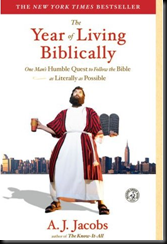
Recommended: The year of living biblically

One of my biggest failures and complains is that I don’t make much time to read, and that’s something I love to do.

imageAbout six months ago, one of my favorite bloggers (Tim Ferris), blogged about a new book coming out: “The Year of Living Biblically: One Man's Humble Quest to Follow the Bible as Literally as Possible”, the title clicked immediately with me because of how I was feeling at the time, but did I really needed this book?, dug a bit deeper and found A.J. Jacobs site, here he posted an excerpt of his book, loved his style and what he was trying to do (I strongly suggest you check it out), I got the book right away.

I finally finished reading it today (I kept postponing it because of work) and I LOVED IT!

The book is overly entertaining, yet I did learn A LOT about the bible and the differences between several religious groups, the author is very sensitive (and hilarious) in his approach, and I found it very light to read and still intellectually interesting, so much so that I decided to post it in the blog.

Click here to see the Book in Amazon.

Faith Scavenger

Thursday, October 9, 2008

Faith in the Bible… help me find it please?

I had a discussion with a good friend about one of my posts, he told me I should not approach the bible or God with reason and logic (an argument used by myself many times in the past), because Christianity is about Faith and not about logic, he reminded me the bible says:
 
“But the natural man receiveth not the things of the Spirit of God: for they are foolishness unto him: neither can he know them, because they are spiritually discerned.” 1st Corinthians 2:14
 
Do you think Abraham, the father of faith, or any of Jesus' disciples have any merit when it comes to faith?, I asked.
“Of course!”, he replied with energy. -“well, I don’t know about you, but if God, or an angel, appears before me right now, I’m convinced I’d have as strong a faith as that of those in the bible, period… that’s not hard, is it?”, I proceeded.

When I think about the disciples, these were fishermen, overall simple men that Jesus “recruited” for bigger purposes, but, why did they follow him in the first place?, well, Jesus did not preach the gospel like you and me, he had superpowers (or miracles as the bible calls them), Why do this if it was all about having faith? IMHO it is very simple to believe a guy walking on water with X-ray vision into our hearts and minds, one who on top of it all claims to be “The Son Of God”.
 
As with most recent conversations with Christian friends, this one ended in similar fashion, in short, awkward…
 
I decided to dig a bit deeper into the subject, I’ve read the bible several times but I honestly did not remember why exactly he was called “The Father of Faith”, so I read Abraham’s story and made some notes:
  • God called Abraham and he promised he was to become father of nations.
  • Abraham lied and lacked faith in several occasions.
  • God promised him a son (Sarai was old and unable to have children, Abraham was over 90 years old)
  • Abraham and Sarah lacked faith and tried to “help God” conceiving a child from a different woman.
  • Some years later, God gave him them THE son, Isaac.
  • God asked Abraham to kill his son as a sacrifice to him, but only as a test, so God stopped him before and provided a lamb to be sacrificed instead.

That’s it, in an ultra high-view nutshell; as I understand it, the title is given to him because God asked him to and he was ready to sacrifice his most beloved gift on Earth, his Son. Evidently, this is no small potatoes, it is his son; however, I must say that if I hear a God whose promises turn real, a God whom I can have arguments and discussions with, a God that destroys cities in front of my eyes and a God that gives me a Child after 90 years old with a barren wife (and sex-drive at that age), do I, after all this, need more proof he is the almighty God he says he is?

What do you think?
Wasn’t it easier to believe with a God that interactive in those days?
Don’t we have the short end of the stick now?

Faith Scavenger